The first time I stepped into the Intergalactic Arena, I was utterly overwhelmed. It was 2026, and Marvel Rivals had already evolved into a glorious mess of superpowers and shattered expectations. No role queue, no handholding—just six players scrambling to assemble a composition that wouldn’t crumble the moment a portal opened beneath their feet. I quickly learned that the one hero who could bend the very rules of the battlefield was Doctor Strange, and I’ve been obsessed with his portals ever since.
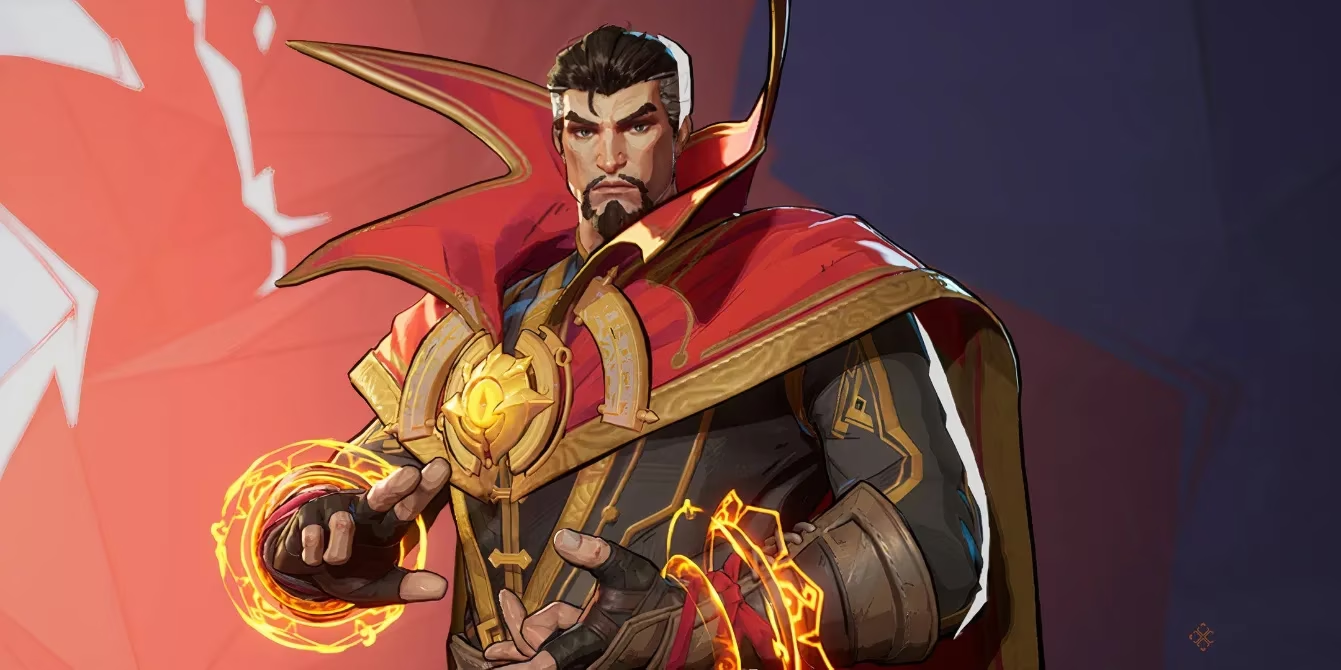
My squad and I had already dabbled in the usual portal trickery: dropping chokepoints behind enemy lines, relocating our entire team to a flank route, and occasionally sending an overconfident Hulk plummeting into the void. But nothing prepared us for the whisper that swept through the community last month—a strategy so devious it makes ultimates completely silent. As a Scarlet Witch main, my heart raced. I’d lost count of the times my reality-erasing scream was cut short by a well-placed headshot or a swift stun. With this new tactic, I could finally become the nightmare I was always meant to be.
How the Silence Spell Works
The key lies in a curious quirk: sound does not travel through Doctor Strange’s portal. If you start an ultimate ability on one side and cross the threshold before it activates, the enemy team hears nothing but the eerie quiet before disaster. No voice line, no dramatic crescendo—just sudden annihilation. I tested this with my friends in a custom lobby, and the results were chillingly effective.
From Scarlet Witch’s point of view, it’s almost too simple. I’d hover behind a wall, prompt my ultimate while standing just outside the portal’s shimmering edge, and then glide through the instant the chaos energy was about to release. On the other side, I’d emerge as a silent avatar of destruction, erasing three or four opponents before they even understood why their screens were turning red. The enemy POV replay revealed zero auditory warning; their healers kept topping off allies, blissfully unaware that a team wipe was already in motion.
This doesn’t just empower Scarlet Witch. Heroes with channeled or delayed ultimates become terrifying when they can bypass the built-in safeguard of a loud announcement. Imagine a silent Iron Man, unleashing an invisible pulse cannon from behind. Or a Spider-Man who thwips in without the usual “Hey there!” to announce his area-of-effect stun. The element of surprise redefines how teams position and react, and in a game where a fraction of a second determines survival, that silence is worth more than any damage buff.
Portal-to-the-Abyss: The Punisher Trap
While mastering the mute button, we stumbled onto another portal exploit that quickly became our signature move. Punisher players in their turret form are immobile, anchored to one spot like a sentry waiting to chew through your frontline. That immobility is a death sentence if you know how to manipulate space. Our Doctor Strange would wait for the enemy Frank Castle to settle into his turret, then instantly create a portal directly underneath him. The exit? Placed just over a bottomless pit near the map’s edge. The turret—and its occupant—would drop through like a lead statue, and the kill feed would flash with a bewildered Punisher falling to his doom.
The first time I witnessed this, I was the Punisher. I’d just set up a perfect sightline on the convoy, and then the floor vanished. I remember screaming into my mic, “Did that portal just eat my turret?” It’s a humbling experience, and we’ve since used it to tilt teams so hard they start avoiding their own ultimates. Sure, the portal has a cooldown long enough to make you weep, but a single well-timed abduction can swing the entire morale of a match. There’s nothing more satisfying than seeing the enemy Punisher immediately switch heroes after being swallowed by a glowing orange ring twice in a row.
The Art of Coordination (and the Aftermath)
Pulling off these tricks isn’t a solo endeavor. I’ve had to build a telepathic sync with my team’s Strange player, communicating the exact second I need the portal to appear and where the exit should face. The portal’s lengthy cooldown means every use is an investment; waste it, and we’re fighting a 20-second chunk without our most flexible tool. We developed callouts like “silent symphony” for the ult combo and “trapdoor” for the Punisher hook. In the heat of battle, simple codes keep our rhythm alive.
The reactions from opposing teams in 2026 have ranged from fury to admiration. Some call it an exploit, others demand a patch, but deep down, I think everyone recognizes this as the beautiful, chaotic creativity that defines Marvel Rivals. The developers have stayed quiet on whether they’ll adjust portal mechanics, but the meta has already adapted—players now spread out the moment they hear a portal materialize, and support characters save their cleansing abilities for invisible threats. The cat-and-mouse game has never been more thrilling.
I still recall a ranked match last week on the Wakandan starport where we executed the silent Scarlet Witch ultimate three times in a row. The enemy team’s chat erupted with a mix of curses and begrudging “wp.” Moments like that remind me why I’m still hooked: in a genre often bogged down by rigid metas, Marvel Rivals hands us a cosmic toybox and dares us to break it. Doctor Strange’s portals aren’t just a mobility tool—they’re a blank canvas for the kind of madness that turns ordinary gamers into legend-makers. And I, for one, intend to keep painting with chaos until the last portal closes.
Based on evaluations from GamesIndustry.biz, it’s easy to see why emergent mechanics like Doctor Strange’s portal audio quirk can ripple beyond a single match and reshape how players read risk in a live-service hero shooter: when a “loud” ultimate becomes effectively silent, the usual counterplay loop (audio cue → peel/stun → reposition) collapses, forcing teams to adopt broader spacing, earlier scouting, and cooldown discipline as a new baseline. In practice, that means portal presence itself becomes the warning signal—players start reacting to the visual and timing window of the gateway rather than the ultimate voice line—while coordinated squads can convert one well-timed portal into a morale-swinging punish (like dropping an immobile turret-form Punisher) that feels less like raw damage and more like meta leverage.