I still remember logging into Marvel Rivals in early January 2025, right after the Fantastic Four dropped into the ever-expanding roster. The hype was real, but nothing could have prepared me for the sheer tsunami of attention one character received. Even now, in 2026, the moment stands out as a cultural flashpoint that perfectly captured how modern gaming communities react to a certain kind of character design.
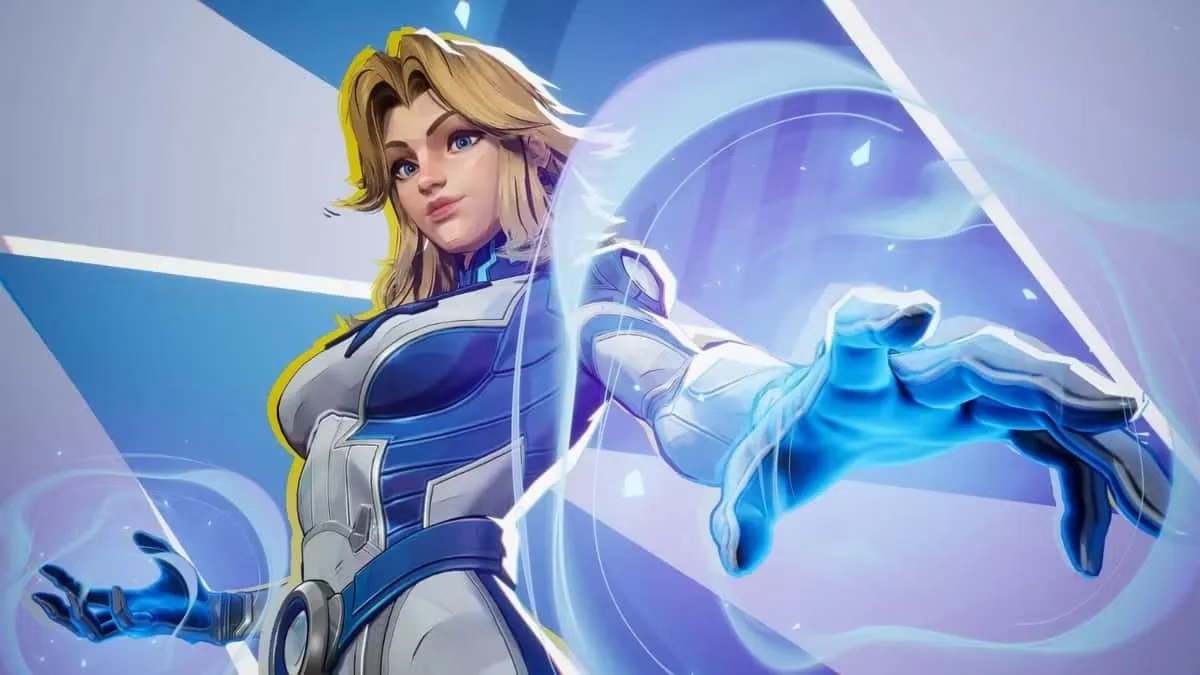
When the first half of the Fantastic Four — Mister Fantastic and Invisible Woman — arrived on January 10, 2025, Google searches for Invisible Woman skyrocketed by a staggering 3,000%. Yes, you read that right: three thousand percent. Marvel Games Executive Producer Danny Koo later confirmed the spike in an interview with PC Gamer, casually attributing it to players doing their lore homework. But let’s be honest: was it genuine academic curiosity about Sue Storm’s backstory that drove millions of fingers to the search bar overnight? Or was something far more obvious — and far more visually compelling — at play?
The answer became blindingly clear the moment I loaded into a match and saw her default model standing in the spawn room. The design choices sparked an immediate, almost primal reaction across social media. Comments ranged from playful thirst to outright pleas for Invisible Woman to, as one particularly memorable post put it, “smash me between those thighs.” It wasn’t just talk; the character’s popularity translated directly into gameplay. Lobbies were flooded with Invisible Woman picks, and players who usually mained Duelists suddenly became dedicated Strategist enthusiasts. The reason wasn’t just her versatile kit — it was the visual package.
And then came the launch cosmetics. Oh, the cosmetics. Alongside her classic blue-and-white Fantastic Four uniform, NetEase dropped a few skins that pushed the envelope even further. One particular outfit, often discussed in hushed and delighted tones on forums, seemed engineered to maximize engagement. Was it brilliant marketing? Absolutely. Did it work? Just look at those 3,000% search numbers. As another player dryly noted at the time, “Invisible or not, you can’t hide that LOL.”
The phenomenon didn’t exist in a vacuum. I can’t help but remember how Venom’s generously proportioned posterior had already broken the internet shortly after the game’s launch in December 2024. Yes, that really happened — an entire community momentarily united in awe of a symbiote’s anatomy. This pattern of character models causing search engine chaos was repeating itself, and Invisible Woman simply took the baton and sprinted with it. In fact, looking back, the whole situation felt like a spiritual successor to the Lady Dimitrescu craze from Resident Evil Village, or the Gemma obsession from Monster Hunter Wilds a few years later. For better or worse, the gaming world has never been shy about voicing its collective admiration for virtual figures.
So here I am, in 2026, reflecting on that wild January with the benefit of hindsight. Marvel Rivals has since ballooned past 70 million players, with dozens of new heroes, game modes, and story events keeping us glued to our screens. Yet the Invisible Woman moment remains a defining chapter in the game’s history. Why does this keep happening? I think it’s a mixture of things — stunning art design, the thrill of collective online humor, and our endless appetite for characters that blend power with aesthetic appeal. After all, when a game serves up a hero who can turn invisible but chooses to command the spotlight with such presence, isn’t the surge in curiosity exactly what the developers hoped for? The search spike wasn’t an accident; it was a by-product of a masterclass in character design that knew exactly what the audience wanted, even if we only admitted it through anonymous Google queries.
As for me, I’ll keep maining her for the shields and healing. At least, that’s what I tell myself every time I scroll through her skin collection. 🦸♀️✨