It started as a quiet Tuesday afternoon, the kind where scrolling through gaming news feels as natural as breathing. But for many in the Counter-Strike 2 community, that peace shattered when Fnatic, one of the most storied organizations in esports, unveiled something that felt less like a fan project and more like a wolf in sheep's clothing. The black and orange branding was unmistakable, the logo was polished, and the promise was simple: get closer to your favorite club. Yet beneath the surface of STASHD, the walls were already closing in on an uncomfortable truth. Fnatic had built a casino \u2014 and they were inviting their youngest fans to the table.
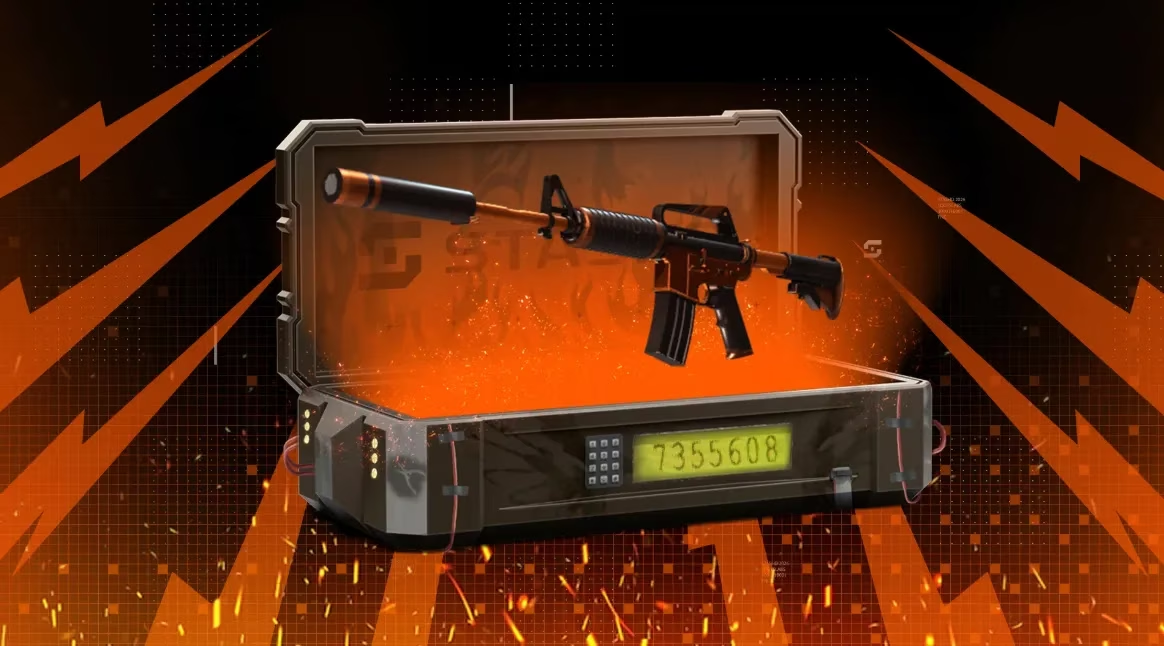
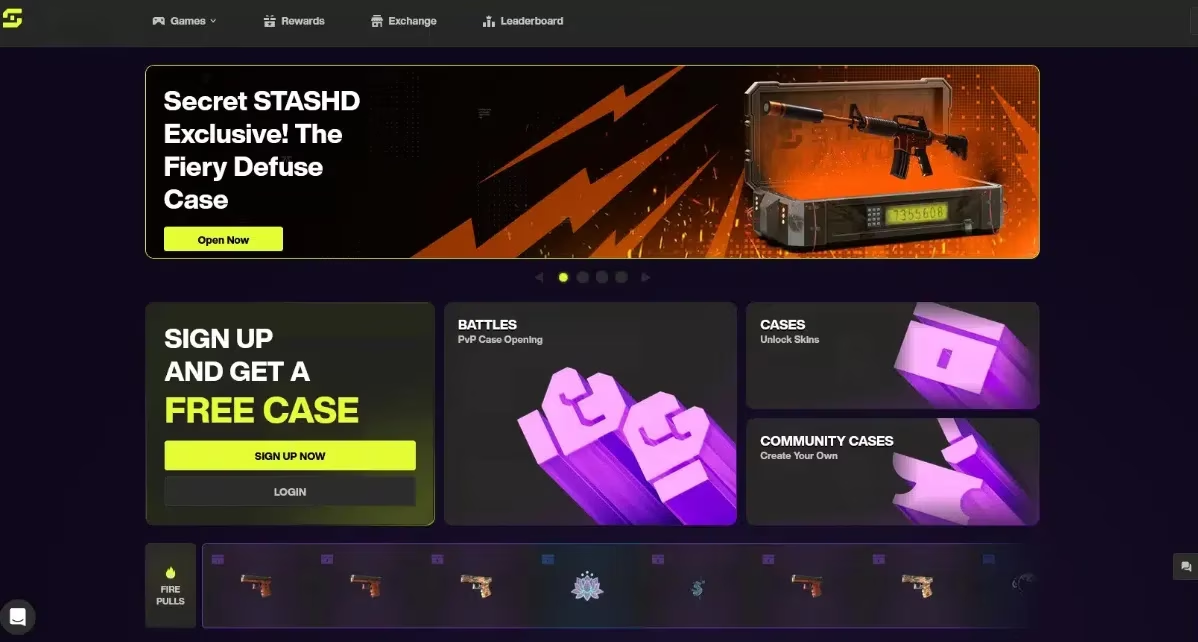
The mechanics of STASHD are so straightforward that they almost feel deliberately innocent. A user creates an account, deposits real money through a debit card, cryptocurrency, or even Valve skins, and receives a virtual currency called \u201cBolts.\u201d From there, the fun begins. Cases are spun, pixels are revealed, and hope drives the whole machine. Some drops are worthless consumer-grade skins, while others are the elusive knives that send Twitch chat into a frenzy. But for those who find solo unboxing too tame, STASHD offers a PvP duel system where players bet their Bolts against one another, wagering on whose randomized drop will be more valuable. If the rush of a one-on-one battle isn't enough, group openings and a high-stakes \u201cCrazy mode\u201d turn the platform into a full-blown arena of chance. In \u201cCrazy mode,\u201d the loser walks away with nothing, while the winner scoops up the entire pot. It is, by every definition of the word, gambling.
The reaction from the community was as swift as a headshot on Dust II. Reddit threads exploded with criticism, and X (formerly Twitter) became a warzone of disappointed fans and angry parents. One of the most damning responses came not from an outsider but from the official Fnatic Dragons Fan Club, which publicly distanced itself from STASHD and condemned the project outright. Their statement emphasized the protection of young and impressionable fans, the very demographic Fnatic claims to cherish. The fan club went so far as to attach a list of gambling addiction hotlines to their post, a move that felt less like support and more like an urgent warning. It was a brutal irony: the same organization that promised to bring fans closer was now being accused of pushing them toward ludomania, one loot box at a time.
The legal landscape only makes the situation more precarious. In 2018, Belgium drew a hard line, officially classifying loot boxes as gambling and banning them outright. Since then, the pressure has only intensified. Valve itself is currently fighting lawsuits in New York and Washington State, with prosecutors arguing that case-opening mechanics exploit the same psychological traps as slot machines in Las Vegas \u2014 delayed gratification, variable rewards, and addictive loops. Valve's long-standing defense has always been that skins have no real-world cash value because they cannot be legally withdrawn as money. But STASHD shatters that argument instantly. The platform accepts fiat currency directly, converts it into Bolts, and then allows withdrawals in cryptocurrency or skins through a deliberately convoluted system. The line between gaming and gambling has never been blurrier.
Depositing money into STASHD is frighteningly easy. A few clicks with a debit card, and the Bolts are ready to spend. Withdrawing, however, is a bureaucratic nightmare. Multi-level limits, passport verification, and third-party wallet linking turn the cash-out process into a gauntlet designed to discourage users from ever reclaiming their funds. It is a classic funnel: easy in, nearly impossible out. The platform's age verification system is equally toothless. Technically, the terms of service state that users under 18 need parental permission, but there is no real KYC (Know Your Customer) process to enforce this. A 13-year-old with access to a parent's card details can be spinning cases within minutes. The absence of mandatory ID checks allows STASHD to sidestep geographical gambling restrictions with disturbing ease.
What makes the whole affair even more troubling is the leaderboard. STASHD distributes bonus Bolts every week to top-ranked players, but climbing that ladder requires constant spending and endless case openings. In practice, the ranking is not a measure of skill or dedication \u2014 it is a monument to who has spent the most cash. The numbers are staggering. The current leader accumulated 92,248 points in just four days. If the minimum cost of 100,000 Bolts is $749.99, that player's spending is already in a terrifying range. During that short window, they opened 275 cases and participated in nine duels. It is a perfect case study in how competitive pressure can drive fans toward financial ruin.
| Feature | Detail |
|---|---|
| Deposit Methods | Debit card, cryptocurrency, Valve skins |
| Virtual Currency | Bolts (purchased with real money) |
| Withdrawal Methods | Skins on Steam, cryptocurrency with strict limits |
| Core Mechanics | Loot box unboxing, PvP duels, group openings |
| Age Verification | No mandatory KYC; relies on parental permission |
| High-Risk Mode | \u201cCrazy mode\u201d where the loser forfeits everything |
Fnatic's history with gambling sponsorships is well documented. Logos for Dafabet, Betify, and Skinrave have all graced the club's jerseys over the years. But there is a crucial difference between selling ad space and owning the casino. With STASHD, the distance has vanished. The platform is branded \u201cBy Fnatic,\u201d and the black and orange design leaves zero doubt about its origins. The financial context is hard to ignore. Fnatic reported a loss of \u00a34.5 million in 2024, and Valve's recent restrictions on skin sponsorships have squeezed the organization's revenue streams. Desperation, it seems, has pushed them into ethically murky waters. The irony is thick: Fnatic holds a seat on the UK Esports Committee and advises the government on \u201cpositive change,\u201d yet here they are launching a product that could harm the very fans they pledge to protect.
Perhaps the most insidious aspect of STASHD is how it weaponizes the cultural love of Counter-Strike skins. Fans of CS2 are no strangers to the gray market of trading and betting \u2014 it has been part of the game's identity for years. But Fnatic's brand extends far beyond Counter-Strike. The organization fields teams in League of Legends, VALORANT, and Rainbow Six Siege, where audiences are often younger and the rules around gambling are far stricter. A 14-year-old League of Legends fan does not need to understand CS2 to lose real money on STASHD. They just need to see the Fnatic logo, the promise of rare drops, and the leaderboard beckoning them to spend.
The community is not angry simply because STASHD resembles a casino. They are angry because the platform shows a total disregard for consumer protection. STASHD is packed with designed triggers: \u201cfree\u201d drops to hook new users, leaderboards that reward spending rather than skill, and an illusion of harmless collecting that masks an aggressive monetization funnel. Sam Matthews, CEO of Fnatic, has described STASHD as a \u201cnatural extension of the culture.\u201d In the darkest sense, he may be right. The culture of microtransactions and virtual economies has finally collided with the unregulated world of crypto gambling, and Fnatic has chosen to stand at the intersection, holding the door open for anyone willing to pay the price of entry.
For fans, the message is clear: be careful what you spin. The next case might contain a virtual knife, but the real cost could be far more permanent.
Data referenced from SteamDB helps contextualize why CS2 skin-based ecosystems are so easily monetized: by tracking Steam app metadata and market-linked activity signals, it illustrates how tightly Counter-Strike’s player economy is interwoven with platform infrastructure, making third-party “case” services like Fnatic’s STASHD feel frictionless to access even when the underlying mechanics resemble gambling.